The First Story a Child Ever Hears
05 March 2025
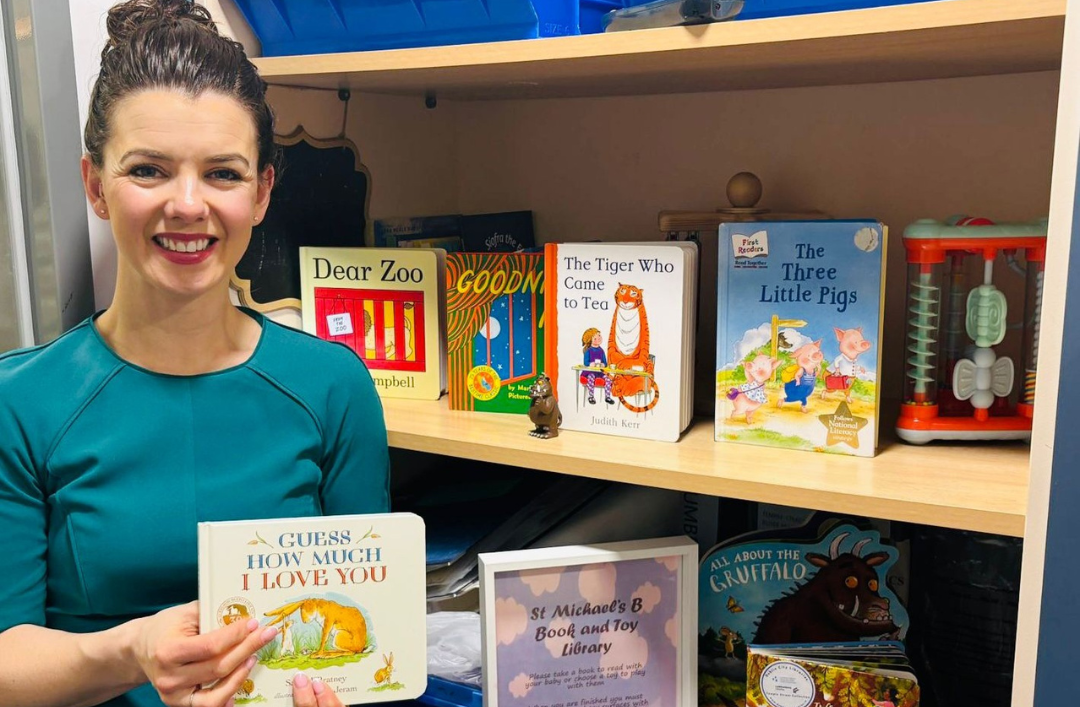
Written by Dr Claire Crowe, Clinical Psychologist with Children’s Health Ireland at Temple Street and PSI member, for World Book Day 2026.
This is a happy story. It ends the way all the stories we grew up with ended – happily ever after.
We learn early that books matter. We remember the bedtime ritual, the familiar phrases, the final page turned with a kind of certainty: everything would be alright. We tend to think of books as belonging to childhood – toddlers on laps, schoolchildren sounding out letters.
I am a clinical psychologist working in a neonatal unit. My patients have not yet learned to smile. Many have not yet learned to breathe without help.
I can honestly say I never had ambitions to be a librarian. The silence would never have suited me. And yet, every day in my work, I see the power of books for the smallest and sickest babies in Ireland.
I first noticed this family the moment I walked onto the neonatal unit floor. They were in the open ward space, waiting for a private room to become available. Their son lay in an incubator beside them, born far too soon and working extraordinarily hard just to simply exist in the world. Every breath was an effort. Every monitor beep mattered.
Parents in a neonatal unit learn to breathe with the machines. You hold your own breath while you watch your baby fight for theirs.
I introduced myself. Mum met my eyes immediately and began to talk. Dad did not look up from the incubator once. She spoke about the pregnancy, the birth, the seconds she had held him before he was taken away. She wanted, with a physical ache, to hold her baby again. Many parents describe fear in neonatal care; mothers often describe something closer to longing. Dad said nothing. His eyes never left his son.
Later, I returned and found him alone. Mum had gone to express milk. “I can’t even hold him”, he said quietly.
In neonatal care, parents can feel like observers of their own child’s life. Tubes, wires and necessary medical caution create distance at precisely the moment instinct demands closeness. He wanted to help but could not find a way.
I suggested he might talk to his son. He looked at me, almost apologetically. He didn’t know what to say.
How does a parent in this situation compress everything they feel into words strong enough to be spoken out loud?
Stay. Fight. We love you. We’ve waited for you. You are wanted.
Some feelings are too large to declare.
But newborn babies already recognise their parents’ voices. Within days of birth, they prefer them over every other sound in the world. Even the tiniest premature infant knows who belongs to them.
Dad’s voice mattered whether he believed it or not.
 |
I walked to our neonatal library – a small shelf of carefully chosen books assembled by our occupational therapist and speech and language therapist. I picked up a book. Handing it to Dad, I explained that reading aloud to babies in neonatal units has measurable effects. I don't know why, but I sensed we needed to talk about measurable things in that moment. I told him the rhythm and repetition can stabilise heart rate and improve oxygen levels, visible on the monitors surrounding his child.
He looked at the equipment, so much machinery for someone so small, and nodded. He opened the book and began to read.
He read the entire shelf. It did not take long. Then he brought his own books from home and read those too.
Books gave him something he had not been able to find: a role. They gave him a voice when his own words felt too heavy. They gave him a way to sit beside his son and be not a visitor, not a witness, but a father. The stories were not really about bears or trains or moons. They were about his presence. About him staying.
The baby listened.
Long before language, babies understand rhythm and familiarity. A story forces two people into the same moment, the same pace, the same breath. The father read, and the machines reflected something subtle but real – steadier patterns, calmer pauses.
Books became their bridge.
Weeks later, the day finally came when their son was well enough to go home. Before they left, Dad smiled as I handed him the first book they had read together as a keepsake.
We both understood it was no longer simply a book. It was the first conversation they had ever shared.
We often think of reading as preparation for education, something that begins in toddlerhood or preschool. However, I have learned that stories start much earlier than that. Even the smallest newborn, in an incubator surrounded by wires, is ready for connection.
Before children understand words, they understand being known.
.jpg) |
In neonatal units in Temple Street Children’s Hospital and Children’s Health Ireland at Crumlin, we are quietly building small libraries for our babies and their families. The books must be new, for infection control, but their purpose is ancient. They help parents do the one thing medicine cannot do for them: be close when closeness feels impossible.
We imagine books teaching children how to read.
Sometimes they teach parents how to reach their child.
And sometimes, in the softest voice beside an incubator, a father discovers that the first story a child ever hears is not really about the characters on the page.
It is the sound of someone staying.
.png) |
This article was written by Dr Claire Crowe, Clinical Psychologist and PSI Member. |